
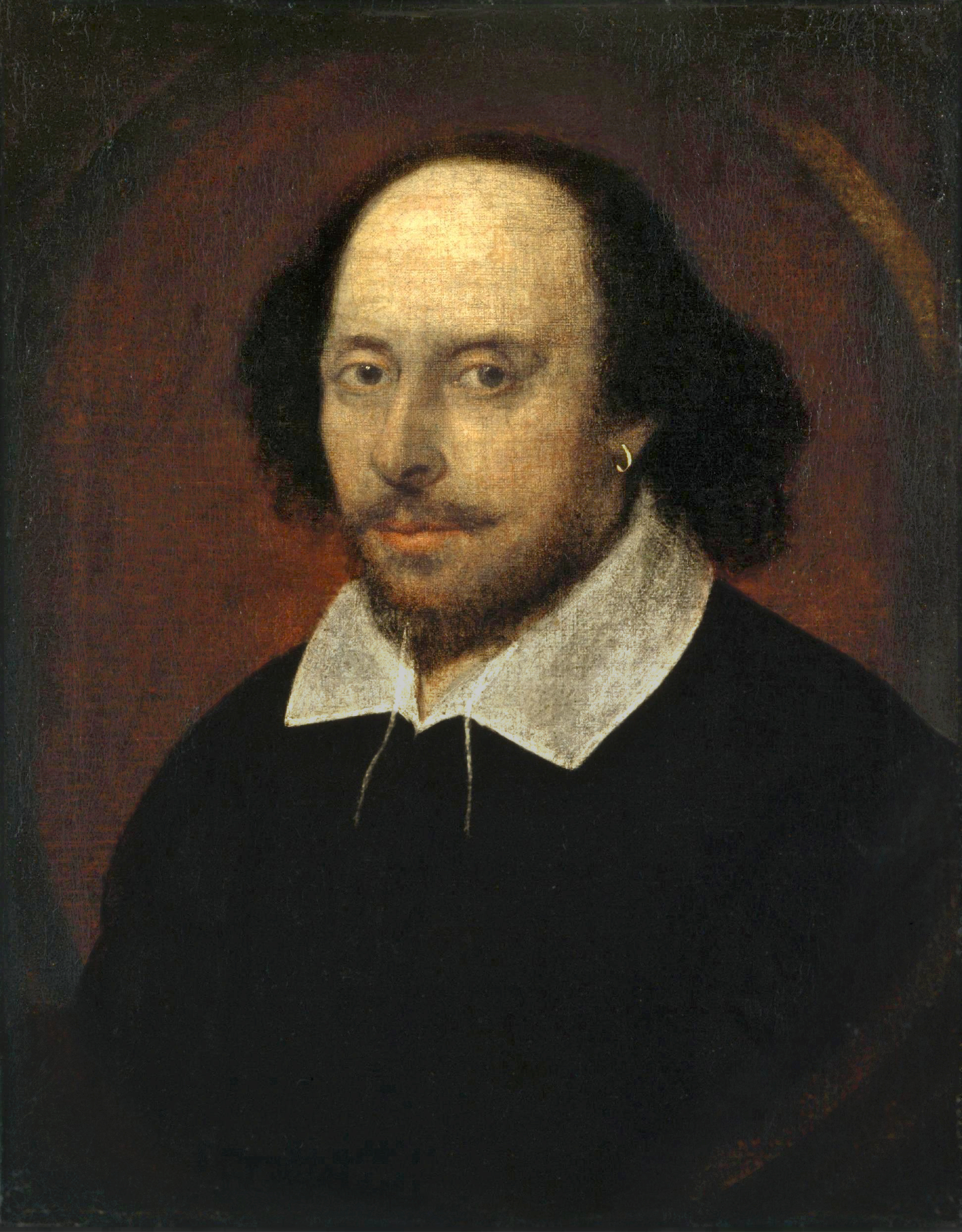
"William Shakespeare" Retrieved from https://upload.wikimedia.org/wikipedia/commons/a/a2/Shakespeare.jpg.
| Connections Sort descending | Author name | Excerpt |
|---|---|---|
| Intertextuality and Influence | Henrietta Camilla Jenkin | The subtitle of this novel (which in earlier centuries had been the title of a bawdy song) here alludes to a proverb about the impossible perfections of maids' husbands and bachelors' children. This first novel... |
| Intertextuality and Influence | Regina Maria Roche | Critic Amanda Burgess
sees this as perhaps the earliest example of the Irish national tale, and of a shift in RMR
's literary focus from England to Ireland which coincided with her own move in... |
| Intertextuality and Influence | Pamela Hansford Johnson | This is a satirical novel set on a US campus—though not, PHJ
insists, embodying any identifiable place or people. The title, from Shakespeare
's Midsummer Night's Dream, suggests that the campus of the story... |
| Intertextuality and Influence | Anna Maria Mackenzie | The title-page bears a quotation from Shakespeare
; the dedication argues that the rebel Monmouth was wrong but deserving of pity. The story traces the fate of a family named Bruce; it opens with a... |
| Intertextuality and Influence | Catherine Gore | The title-page quotes Shakespeare
's Richard II about the deposing of a king. The novel opens with precision: at five o'clock on 22 June 1791, with aristocrats fearful for their fate in the aftermath of... |
| Intertextuality and Influence | Maria Theresa Kemble | Its plot is of the same type as that of Shakespeare
's The Taming of the Shrew.William Shakespeare |
| Intertextuality and Influence | Frances Jacson | |
| Intertextuality and Influence | Bryony Lavery | Ophelia: A Comedy, a rewriting of the play-within-a-play in Shakespeare
's Hamlet, mercilessly scrambles the plot, and has assimilated characters from other plays: Portia, Goneril, Lady Capulet, Juliet's Nurse, and Cleopatra's Charmian. Charmian... |
| Intertextuality and Influence | Candia McWilliam | All the characters are fond of aphorisms (from Anne we get Bitterness is wanton, like showing the hangman the gauge of your neck . . . . It also comes easily to lazy sentimentalists McWilliam, Candia. A Case of Knives. Bloomsbury, 1987. 187 |
| Intertextuality and Influence | Rhoda Broughton | RB
's satire here embraces the publishing industry and its pandering to readers' tastes. Emma's cousin Lesbia is apparently representative of a particular type of circulating-library reader; much to Emma's mortification, she likes Miching Mallecho... |
| Intertextuality and Influence | Bernardine Evaristo | BE
substitutes another name for the surname she shares with her father, but gives her mother's birth name as in life. Her narrator is not Bernardine but Lara, short for Owolara, which means the family... |
| Intertextuality and Influence | Ella Wheeler Wilcox | Without ever owning the complete works of Théophile Gautier
, Alphonse Daudet
, Shakespeare
, Byron
, or Swinburne
, she read bits and pieces of them all, and they helped to shape her style... |
| Intertextuality and Influence | Jane Harvey | The title-page quotes Shakespeare
. This novel follows, with serious concern as well as satirical humour, the career choices made by the sons of the Cleavland family. Their father favours science and agriculture, which he... |
| Intertextuality and Influence | Mary Julia Young | The earlier Adelaide and Antonine, whose lovers take refuge from the French Revolution in England, is balanced by Agnes, or The Wanderer, whose protagonist (another Revolution victim) is ordered by her doomed husband... |
| Intertextuality and Influence | Regina Maria Roche | The heroine suffers under not one but two bad mother-figures, neither of whom is her birth mother. It opens with Greville, a country curate whose spirit has been wounded by the vice and deceit of... |
No timeline events available.
No bibliographical results available.