
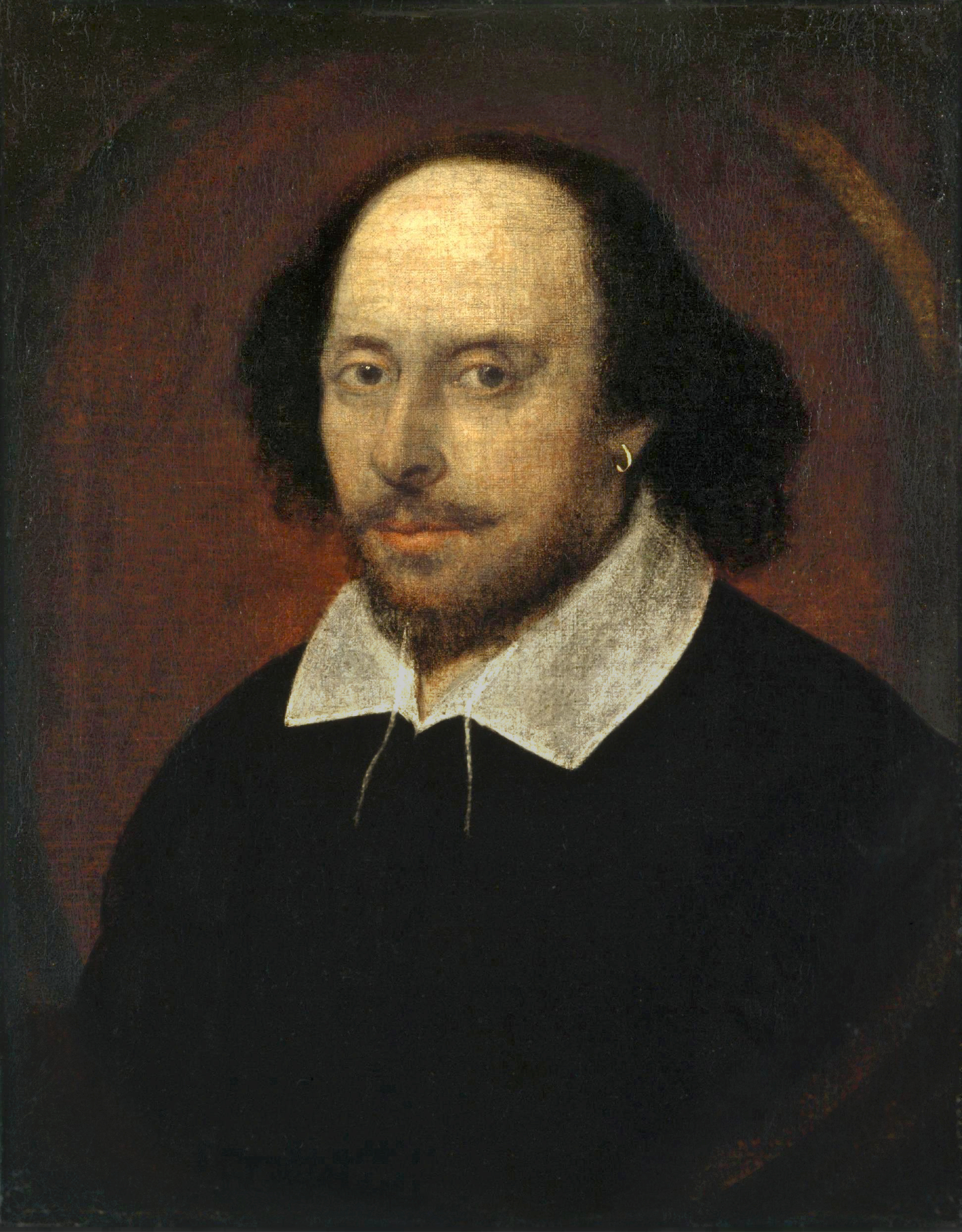
"William Shakespeare" Retrieved from https://upload.wikimedia.org/wikipedia/commons/a/a2/Shakespeare.jpg.
| Connections Sort descending | Author name | Excerpt |
|---|---|---|
| Intertextuality and Influence | Barbara Hofland | The title-page quotes Shakespeare
, which in the context of BH
's epigraphs to other tales titled from virtues gives him almost scriptural status. This time the heroine is not reflective from the beginning, but... |
| Intertextuality and Influence | Margaret Drabble | Imagery of postpartum fluidity, particularly lactation, characterizes the lovers' growing passion and the descriptions of female sexual desire and orgasm. The narrative alternates between a schizoid third-person dialogue Drabble, Margaret. The Waterfall. Penguin, 1971. 130 |
| Intertextuality and Influence | Rose Tremain | Most of the stories concern love, and some make creative use of the lives or works of other authors, like Tolstoy
and Daphne Du Maurier
. In The Closing DoorRT
created a character who... |
| Intertextuality and Influence | Ali Smith | This novel is set in Cornwall, as well as in a contemporary landscape of violent exclusion, lies, suffering. Harris, Alexandra. “Book of the day. Winter by Ali Smith review—wise, generous and a thing of grace”. theguardian.com, 27 Oct. 2017. |
| Intertextuality and Influence | Mrs Martin | The title-page quotes Shakespeare
's Romeo and Juliet, Oh serpent heart . . . . Though slightly schematic in plan, the novel features lively and winning pictures of family life. The marriages made by... |
| Intertextuality and Influence | Pat Arrowsmith | PA
kept a very detailed diary between the ages of thirteen and fifteen. She published excerpts and illustrations from it, with passages from her two juvenile novels, in I Should Have Been a Hornby Train... |
| Intertextuality and Influence | Josephine Tey | Although Shakespeare
's Richard III clearly plays a major role in shaping the myth of Richard's villainy against which Tey writes, she alludes to this play only in passing, when a character comments on Laurence Olivier |
| Intertextuality and Influence | Ada Leverson | This novel is a comedy of manners set in London in springtime, the start of the social season. Critic Charles Burkhart
suggests that the title alludes to Shakespeare
's Twelfth Night; it also, paradoxically... |
| Intertextuality and Influence | Edna St Vincent Millay | She writes often here about the landscape and plants at Steepletop, using them as a metaphor for life and joy and the past. The final piece included in her Selected Poems, 2003, a... |
| Intertextuality and Influence | Mary Webb | The title refers primarily to a legend about a wand of palm (the country name for willow) which brings good luck if it is found on Palm Sunday (when, traditionally, English people carried branches of... |
| Intertextuality and Influence | Mrs Ross | Many chapters are headed with quotations from Shakespeare
or Cowper
. This novel pits domestic (upper-class) ties against destructive passions, the latter aroused by the fascinating Marchioness of Laisville (whose vices do not ruin her... |
| Intertextuality and Influence | Felicia Hemans | The volume provides lavish notes to explain its sometimes quite obscure historical figures and settings, and cites a wide range of authors including Plutarch
, Shakespeare
, Milton
, and Germaine de Staël
. FH |
| Intertextuality and Influence | Mrs E. M. Foster | As an epistolary novel, Concealment lacks the characteristic metanarrative of other MEMF
novels, though an interesting prologue addressed to the reader from the Authoress cautions against the practice of concealment. Foster also identifies herself, in... |
| Intertextuality and Influence | Anne Thackeray Ritchie | The novel opens with an epigraph from a Shakespeare
sonnet. Shankman, Lillian F., and Anne Thackeray Ritchie. “Biographical Commentary and Notes”. Anne Thackeray Ritchie: Journals and Letters, edited by Abigail Burnham Bloom et al., Ohio State University Press, 1994, p. various pages. 215 |
| Intertextuality and Influence | Barbara Hofland | The title-page (like several earlier ones of BH
) quotes Shakespeare
. The novel opens in 1726, with Catherine the first
holding court in Russia after Peter the Great
's death. She had come to... |
No timeline events available.
No bibliographical results available.