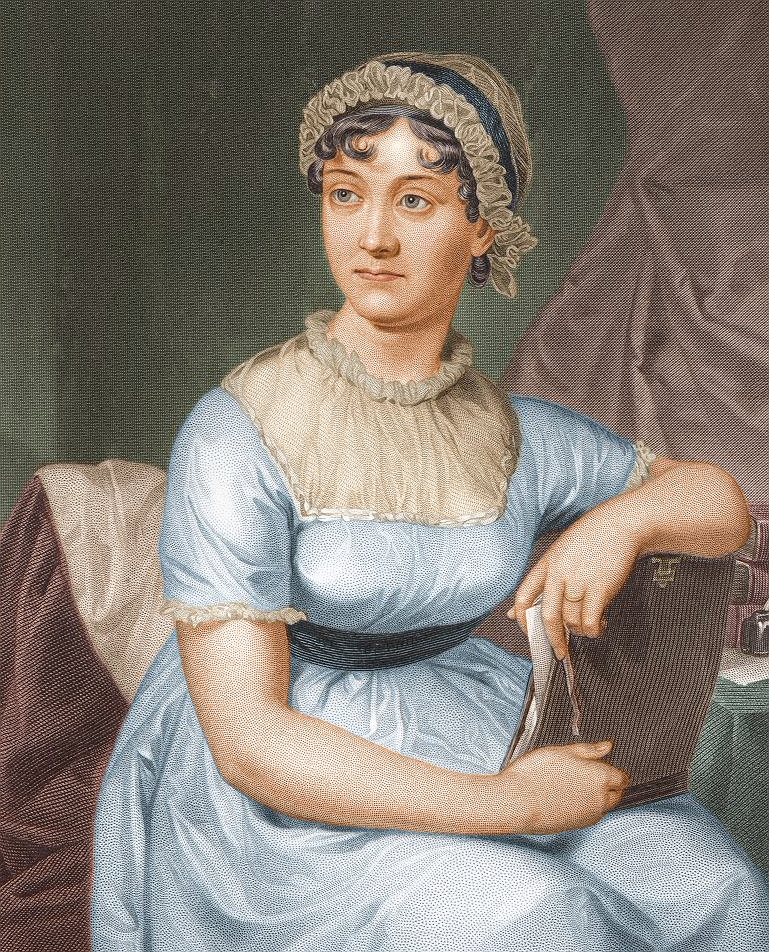
Women’s Writing in the British Isles from the Beginnings to the Present
Jane Austen
-
Standard Name: Austen, Jane
Birth Name: Jane Austen
Pseudonym: A Lady
Styled: Mrs Ashton Dennis
JA
's unequalled reputation has led academic canon-makers to set her on a pedestal and scholars of early women's writing to use her as an epoch. For generations she was the first—or the only—woman to be adjudged major. Recent attention has shifted: her balance, good sense, and humour are more taken for granted, and critics have been scanning her six mature novels for traces of the boldness and irreverence which mark her juvenilia. Her two unfinished novels, her letters (which some consider an important literary text in themselves), and her poems and prayers have also received some attention.
The novel is richly intertextual. Jane Austen
is a source of inspiration: Flora's sole occupational goal for the next thirty years is to collect material for a novel as good as Persuasion, but with...
Intertextuality and Influence
Katherine Mansfield
She opens her review by evoking the experimental, critically controversial current state of the novel, before presenting the surprising picture of Night and Day sailing into port serene and resolute.
qtd. in
Majumdar, Robin, and Allen McLaurin, editors. Virginia Woolf: The Critical Heritage. Routledge and Kegan Paul, 1975.
79
The image of a...
Intertextuality and Influence
Elizabeth Strutt
Influence of Frances Burney
's Evelina is perceptible here, and influence of Jane Austen
seems at least a possibility: a family estate is named Maple Grove, as in Emma, and the heroine's marriage to...
Intertextuality and Influence
Beatrix Potter
BP
was not content with her success as a children's writer, but hankered to establish herself as an author for adults. Her references in her private writings to Burney
(a propos of her first appearance...
Intertextuality and Influence
P. D. James
As the work opens, Cordelia, slight of body, determined of will, savvy of mind
Gidez, Richard. P. D. James. Twayne, 1986.
56
(who is to reappear later in another book, The Skull Beneath the Skin), is running a seedy detective agency...
Leisure and Society
Rumer Godden
With books hard to come by, RG
read and re-read those she had, often sent her by relatives and often new publications. She called Austenexactly what I need and likened herself to Emma.
Godden, Rumer. A Time to Dance, No Time to Weep. Macmillan, 1987.
207
Leisure and Society
Elizabeth Heyrick
In the year 1827 EH
's reading included all of Jane Austen
's completed novels and Mary Russell Mitford
's Our Village.
Beale, Catherine Hutton, editor. Catherine Hutton and Her Friends. Cornish Brothers, 1895.
179
Leisure and Society
Carola Oman
In a letter to the Times in 1962, CO
described a bookcase in her writing-room which held the works she described as All the Winners. For a writer of fairly conservative views and strong...
Leisure and Society
Jennifer Johnston
Although JJ
says she is always reading contemporary young men and women writers coming out of Ireland today,
Moloney, Caitriona et al. Irish Women Writers Speak Out: Voices From the Field. Syracuse University Press, 2003.
67
in her short list of her most beloved books Ireland is just outnumbered by England and...
Leisure and Society
Edith Somerville
In her later years ES
set out to extend her reading. She tried Woolf
's A Room of One's Own (at the behest of Ethel Smyth
) and admired it. But she could not like...
Literary responses
Elizabeth Jenkins
The novel was criticised by some for its exclusively upper-middle-class reach—a view which was energetically countered by Rose Macaulay
on a radio programme.
Jenkins, Elizabeth. The View from Downshire Hill. Michael Johnson, 2004.
107
The Times Literary Supplement welcomed with joy a novel where the...
Literary responses
Emma Marshall
One of EM
's clerical admirers called this book a particularly strong instance of the way her heroines (if not quite up to Jane Austen
's Anne Elliot or Charlotte Yonge
's Violet in Heartsease...
Literary responses
Mary Elizabeth Braddon
Henry James
's review in 1865 considered Braddon's success alongside that of Collins
, pronouncing her the founder of the sensation novel (defined as devising domestic mysteries adapted to the wants of a sternly prosaic...
Literary responses
Mary Augusta Ward
The novel was a massive success, in the words of Henry Jamesa momentous public event.
qtd. in
Ward, Mary Augusta. “Introduction”. Robert Elsmere, edited by Rosemary Ashton, Oxford University Press, 1987, p. vii - xviii.
vii
Critic John Sutherland deems it the best-selling work of quality fiction in the nineteenth century. By the summer...
Literary responses
Laetitia-Matilda Hawkins
Jane Austen
called this novel very good and clever, but tedious.
Nicholls, C. S., editor. The Dictionary of National Biography: Missing Persons. Oxford University Press, 1993.