Women’s Writing in the British Isles from the Beginnings to the Present
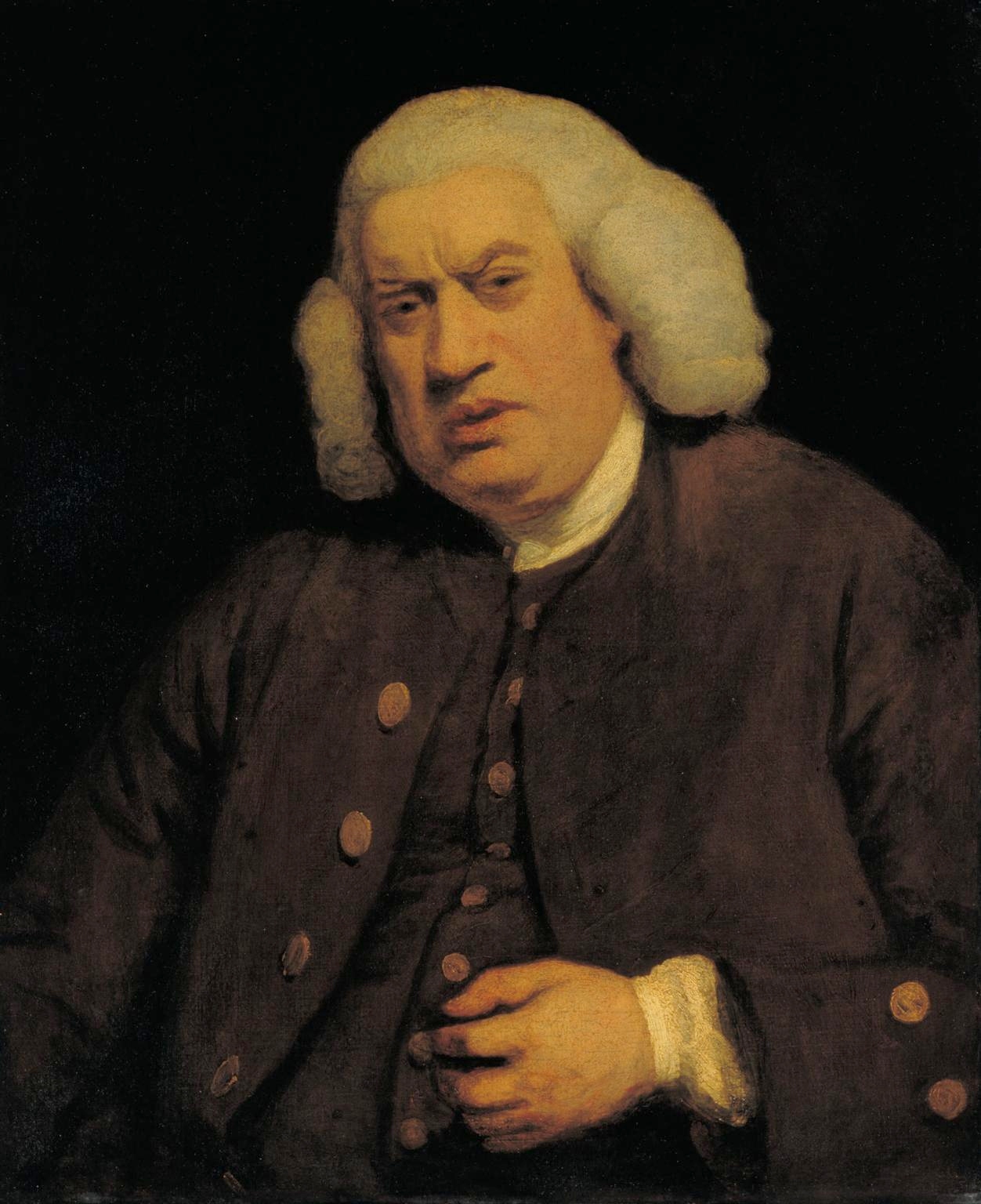
Samuel Johnson
-
Standard Name: Johnson, Samuel
Used Form: Dr Johnson
Arriving in eighteenth-century London as one more young literary hopeful from the provinces, SJ
achieved such a name for himself as an arbiter of poetry, of morality (through his Rambler and other periodical essays and his prose fiction Rasselas), of the language (the Dictionary), and of the literary canon (his edition of Shakespeare
and the Lives of the English Poets) that literary history has often typecast him as hidebound and authoritarian. This idea has been facilitated by his ill-mannered conversational dominance in his late years and by the portrait of him drawn by the hero-worshipping Boswell
. In fact he was remarkable for his era in seeing literature as a career open to the talented without regard to gender. From his early-established friendships with Elizabeth Carter
and Charlotte Lennox
to his mentorship of Hester Thrale
, Frances Burney
, and (albeit less concentratedly) of Mary Wollstonecraft
and Henrietta Battier
, it was seldom that he crossed the path of a woman writer without friendly and relatively egalitarian encouragement.
MS
brings her list up to date with significant women writers who have published since the appearance of The Feminead. Her information is not perfect—she credits Anna Williams
with some works actually written by...
Textual Features
Rachel Hunter
RH
defends her project with due modesty in a prefatory dialogue with a reader whom she calls Mr Not-At-All (after the opening words of all his answers). She says she writes for the improvement of...
Textual Features
Sarah Fielding
David Simple predates all fictional work by Samuel Johnson
and all but the earliest works by Henry Fielding
and Samuel Richardson
, which are sometimes mistakenly spoken of as its models. It may be seen...
Textual Features
Frances Brooke
Mary Singleton, supposed author of this paper, with its trenchant comments on society and politics, is an unmarried woman on the verge of fifty,
qtd. in
McMullen, Lorraine. An Odd Attempt in a Woman: The Literary Life of Frances Brooke. University of British Columbia Press, 1983.
14
good-humoured as well as sharply intelligent: a contribution to the...
Textual Features
Catharine Macaulay
In the copyright row provoked by unauthorised reprints by the Edinburgh publisher Alexander Donaldson
, CM
began by asking what practices would benefit literature, and concluded that publishers needed to be able to count on...
Textual Features
Lucy Hutchinson
Lucretius
, as a pagan philosopher and theologian (and, as LH
and her contemporaries believed, insane much of the time and sexually promiscuous), was a daring choice for one of her religious opinions.
Lucretius, and Lucretius. “Introduction”. Lucy Hutchinson’s Translation of Lucretius, "De rerum natura", edited by Hugh De Quehen, translated by. Lucy Hutchinson, University of Michigan Press, 1996, pp. 1-20.
8, 11
Textual Features
Elizabeth Burnet
This journal includes much philosophical writing. EB
's detailed critique of the mystic Antoinette de Bourignon
(correspondent of Anna Maria van Schurman
) embodies an ingenious rational explanation of enthusiasm or belief in a divine...
Textual Features
Sarah Fielding
This is a work of fiction, not documentary. It relates the stories of four ex-prostitutes sympathetically, presenting a strong argument for social reform. According to scholar Katherine Binhammer
, it is the most feminist among...
Textual Production
Angela Thirkell
Her title comes from an anecdote in Boswell
's The Life of Samuel Johnson, about a man who tried to be a philosopher, but could not manage it because cheerfulness kept breaking in.
Textual Production
Anne Finch
One passage from a long Pindaric ode entitled All is Vanity (present in Finch's early octavo ms and in her printed collection) has broken loose and achieved a life of its own. Whereas the entire...
Textual Production
Susanna Haswell Rowson
During her work on this novel SHR
was appearing regularly on stage, learning nearly forty different parts, and writing as well three plays, several songs, and an address in verse.
Epley, Steven. “Susanna Rowson’s Bible Abridgement and Its Relationship to Her Most Famous Novel”. American Society for Eighteenth-Century Studies (ASECS) Conference, Boston, MA, 25 Mar. 2004.
Parker, Patricia L. Susanna Rowson. Twayne, 1986.
15
Her preface (on the...
Textual Production
Samuel Beckett
In late 1937 SB
was at work on a play about the relationship between Samuel Johnson
and Hester Thrale
,
Cohn, Ruby. Back to Beckett. Princeton University Press, 1973.
ix-x
which he intended to begin with her death (many years, therefore, after the relationship...
Textual Production
Susannah Dobson
Samuel Johnson
supposed, nearly a decade after its production, that The Life of Théodore Agrippa d'Aubigné, 1772, was by SD
: actually it was the last work of Sarah Scott
, who always published anonymously.
Johnson, Samuel. The Letters of Samuel Johnson. Editor Redford, Bruce, The Hyde Edition, Princeton University Press, 1992–1994, 5 vols.
4: 147
Textual Production
Mary Bosanquet Fletcher
Mary Bosanquet (later Fletcher)
wrote almost weekly to the ex-fashionable preacher Dr William Dodd
(in prison for forgery) until he was hanged, out of concern for his soul.
The following year came A Spelling Dictionary, Divided into Short Lessons, for the Easier Committing to Memory. This was, as the title-page acknowledged, selected from Johnson
's Dictionary. It presented words in groups...