
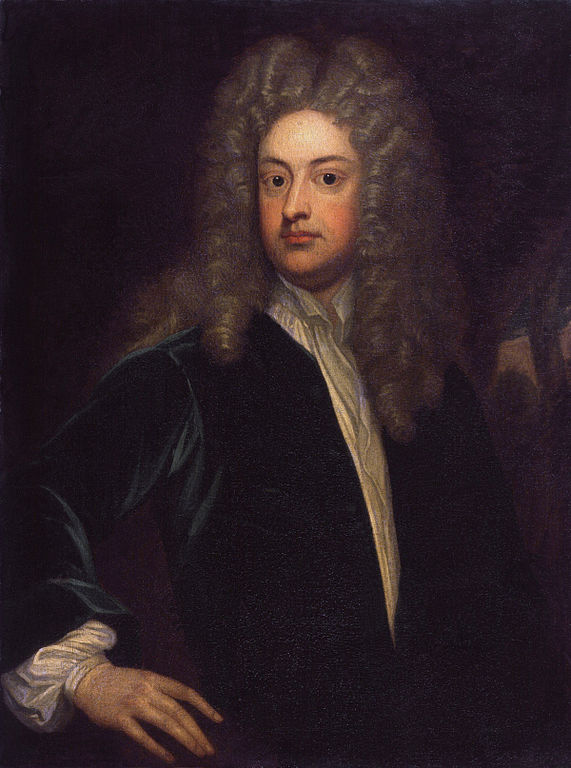
"Joseph Addison" 2010-10-17. Retrieved from https://upload.wikimedia.org/wikipedia/commons/thumb/6/6e/Joseph_Addison_by_Sir_Godfrey_Kneller%2C_Bt.jpg/571px-Joseph_Addison_by_Sir_Godfrey_Kneller%2C_Bt.jpg.
| Connections Sort descending | Author name | Excerpt |
|---|---|---|
| Intertextuality and Influence | Elizabeth B. Lester | |
| Intertextuality and Influence | Mary Savage | The opening poem, Nothing New, situates the anxieties of authors in regard to critics in the tradition of anxieties of lovers: both are right to be anxious. The contents include an English translation of... |
| Intertextuality and Influence | Sarah Lady Cowper | The diary's first volume opens with a preface which expresses conventional modesty bluntly, without the customary effort at elegance or grace: Books generally begin with a Preface which draws in the Reader to go on... |
| Intertextuality and Influence | Sarah Pearson | An introductory address To the Reviewers urges them (with the trembling deemed appropriate for a woman writer) not to read the book in the morning but in the period of good humour after dinner. Pearson, Susanna. The Medallion. G. G. and J. Robinson, 1794, 3 vols. 1: 7-8 |
| Intertextuality and Influence | Anna Miller | Along with works of art she describes, but more briefly, the way of life of places she passes through. She has, however, little sympathy with working people's needs. She remarks that actresses and dancers have... |
| Intertextuality and Influence | Martha Fowke | These poems reflect social life and perhaps the company of lawyers in the London of about 1720. Guskin, Phyllis J. “’Not Originally Intended for the Press’: Martha Fowke Sansom’s Poems in the Barbados Gazette”. Eighteenth-Century Studies, Vol. 34 , No. 1, 2000, pp. 61-91. 66 |
| Intertextuality and Influence | Eliza Haywood | This was the first periodical for women to take advantage of the monthly format, which was still fairly new. Unlike other magazines, it used fiction as its staple, while also including advice on behaviour, relationships... |
| Intertextuality and Influence | A. Woodfin | She learns to condemn her parents' treatment of her when she boards in a family who deliberately favour the ugly, deformed one of their young twins, to redress the balance. She feels a great relief... |
| Intertextuality and Influence | Jane Wiseman | Her poems, full of character and ingenuity, spring from social interchange. The title piece is a longish, narrative, occasional poem, Sent with a Pair of China Basons Wiseman, Jane. “A Fairy Tale, Inscrib’d, to the Honourable Mrs. W— With Other Poems (1917)”. Eighteenth-Century English Labouring-Class Poets, 1700-1740, edited by William Christmas, Pickering and Chatto, 2003, pp. 34-46. 34 |
| Intertextuality and Influence | Lady Mary Wortley Montagu | Her widow is President of a club of widows which had featured in the recent number 561, by Addison
. Montagu's heroine, sold into marriage at an early age, has resolved to exploit as the... |
| Intertextuality and Influence | Anna Letitia Barbauld | ALB
's niece
wrote of her (with an echo of Pope
on himself) that while yet a child, she was surprised to find herself a poet. qtd. in McCarthy, William et al. “Introduction”. The Poems of Anna Letitia Barbauld, University of Georgia Press, 1994, p. xxi - xlvi. xxviii |
| Literary responses | Delarivier Manley | |
| Occupation | John Milton | As to poetry, Paradise Lost was quickly recognised as a classic. In 1674, while it was still a very recent text, Dryden
praised it as undoubtedly one of the greatest, most noble, and most sublime... |
| Reception | Elizabeth Helme | The Critical reviewed this novel two months after publication. It goes unmentioned by Virgil B. Heltzel
in Fair Rosamond. A Study of the Development of a Literary Theme, 1947. Those preceding Helme in treating... |
| Reception | Eliza Haywood | In 1795, by which time the novel was generally disapproved as coarse and sexually explicit, a correspondent of the Eleanor Butler
and Sarah Ponsonby
defended it in terms which acknowledged its indelicate language and its... |
No timeline events available.
No bibliographical results available.