
Matthew, Henry Colin Gray et al., editors. Oxford Dictionary of National Biography. http://www.oxforddnb.com/.
George Bernard Shaw
-
Standard Name: Shaw, George Bernard
Used Form: G. B. Shaw
GBS
was a drama critic who called for reform of theatrical practice, and a dramatist who attached to his plays on publication, lengthy prefaces expounding the social and dramatic issues opened by the play itself. He won the Nobel Prize in Literature in 1925. The Oxford Dictionary of National Biography calls him a polemicist, and says that much of the drama of his time and after was indirectly in his debt for his creation of a drama of moral passion and of intellectual conflict and debate.
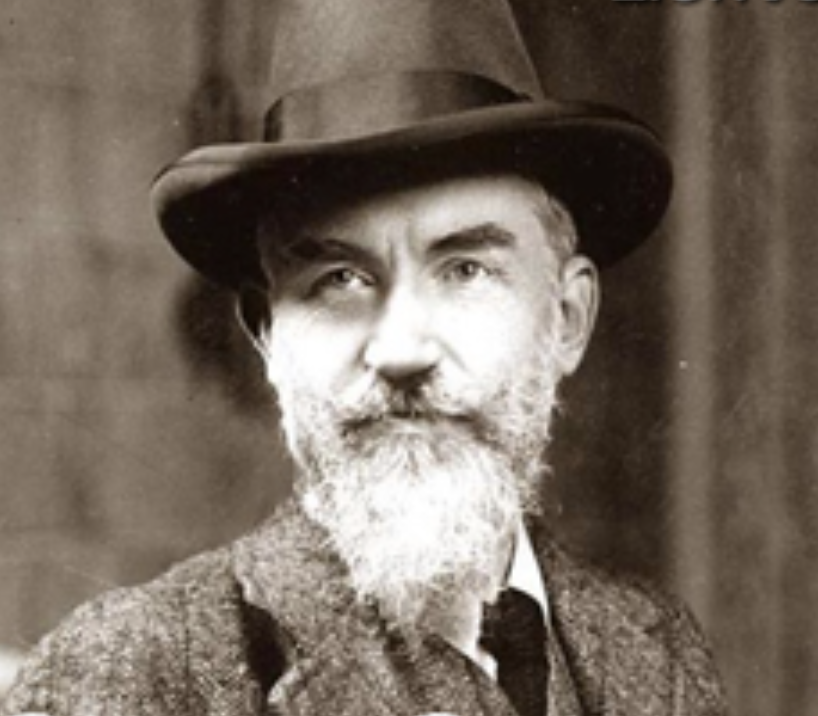
"George Bernard Shaw" Retrieved from https://archive.org/details/george_bernard_shaw_rc_0808.
Connections
| Connections Sort descending | Author name | Excerpt |
|---|---|---|
| Intertextuality and Influence | Mary Elizabeth Braddon | It tells the story of a rich heiress who takes in and refines a beautiful London flower-seller. In present-day Kent on the Castle estate of her ancient aristocratic family, Lady Lucille Ingleshaw, aged seventeen, encounters... |
| Intertextuality and Influence | Teresa Deevy | TD
began writing as a child, producing stories about family doings for her mother and sisters. During her last years at school, from 1911, the school magazine, St Ursula's Annual, featured her stories. Living... |
| Intertextuality and Influence | Theodora Benson | Robert Browning
's poem to Emily Patmore
, the original angel in the house, is quoted at the head of the first chapter. Unlike TB
's first novel, this is a romance with a consummated... |
| Intertextuality and Influence | Lady Colin Campbell | On the recommendation of George Bernard Shaw
, LCC
was recruited to write as art critic for The World, A Journal for Men and Women, which claimed to have the largest circulation of any... |
| Intertextuality and Influence | Bernardine Evaristo | BE
substitutes another name for the surname she shares with her father, but gives her mother's birth name as in life. Her narrator is not Bernardine but Lara, short for Owolara, which means the family... |
| Intertextuality and Influence | Constance Holme | The title-page quotes W. B. Yeats
: Tread softly, because you tread on my dreams. Holme, Constance. Crump Folk Going Home. Cedric Chivers, 1974. title-page |
| Leisure and Society | Katharine Tynan | This same year KT
attended a meeting of the Browning Society
(founded in the summer of 1881) at which she met George Bernard Shaw
. Tynan, Katharine. Twenty-Five Years: Reminiscences. Smith, Elder, 1913. 357 Matthew, Henry Colin Gray et al., editors. Oxford Dictionary of National Biography. http://www.oxforddnb.com/. under Robert Browning (1812-1889) |
| Leisure and Society | Jane Francesca Lady Wilde | JFLW
became known for the Saturday salon held at her house in Merrion Square, Dublin. The gatherings were attended by writers, actors, scientists, musicians, and public men; the visiting crowd sometimes reaching nearly two... |
| Leisure and Society | Kate O'Brien | As a student in Dublin, KOB
eagerly attended the Abbey Theatre
. This was a period between Synge
and O'Casey
, but she delighted in plays by Shaw
, beginning with Man and Superman. O’Brien, Kate. My Ireland. B. T. Batsford, 1962. 116-17 |
| Literary responses | Ethel Wilson | Negative reviews seemed to repeat Macmillan
's original worry that the collection was half-cooked. Aunt Topaz was characterized by the Canadian Forum as a terrible bore, whom the reviewer found almost as tiresome to... |
| Literary responses | Henrik Ibsen | In The Quintessence of Ibsenism (1891), George Bernard Shaw
catalogues some of the extreme reactions of English theatre critics to the play: Absolutely loathsome and fetid. . . . Unutterably offensive. . . . Most... |
| Literary responses | Enid Bagnold | Call Me Jacky was, as EB
's biographer Anne Sebba
put it, her most disastrous failure yet. Sebba, Anne. Enid Bagnold: The Authorized Biography. Weidenfeld and Nicolson, 1986. 240 |
| Literary responses | Sarah Grand | Feminists, social reformers, and literary men, such as Mark Twain
, George Meredith
, and George Bernard Shaw
, greeted this novel with excitement and appreciation. Mitchell, Sally, and Sarah Grand. “Introduction”. The Beth Book, Thoemmes, 1994, p. v - xxiv. vi |
| Literary responses | Elizabeth Baker | Critic Sheila Stowell
, contrasting Baker's heroine with Bernard Shaw
's more ambivalent characterizations of the New Woman, sees the role of Edith as a clear and positive alternative for women. Stowell, Sheila. A Stage of Their Own. University of Michigan Press, 1992. 103 Weiss, Rudolf. “Versions of Emancipation: The Dramatic World of Elizabeth Baker”. Sprachkunst, Vol. 20 , No. 2, 1989, pp. 305-16. 311 |
| Literary responses | Oscar Wilde | Shaw
's review for The Saturday Review welcomed its modern note. qtd. in Ellmann, Richard. Oscar Wilde. Knopf, 1988. 428-9 |
Timeline
No timeline events available.
Texts
No bibliographical results available.